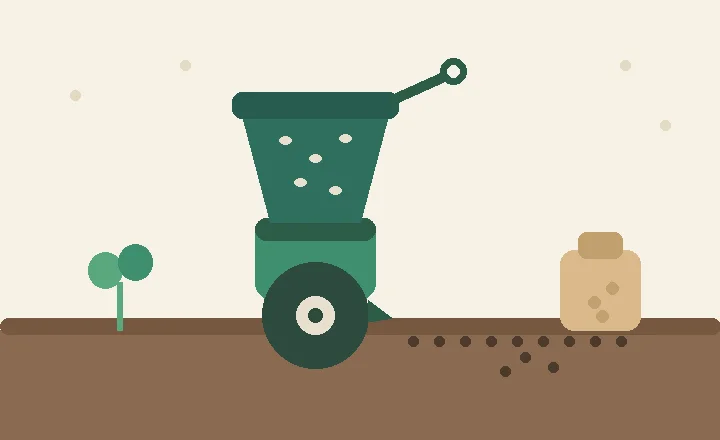
What a seed sower is for
Small seeds can be hard to place by hand, leading to thick sowing or patchy rows. A suitable sower holds seed in a hopper and releases it in a controlled way, which can reduce clumping and excess sowing. Precision metering aims for individual spacing, while a shaker or trickle sower gives a sparse band. Neither removes the need to check seedlings against seed-packet spacing and thin where needed.
Suitability for lettuce, radish, carrot, coriander, onion, celery, beetroot and small flowers depends on the model and its available metering parts. Check the manufacturer's supported seeds and settings, including for larger seeds such as beans, sweet corn or courgettes. For hand placement of individual seeds, you can make holes to the seed-packet depth with a garden dibber. A sower is not a substitute for a fine, crumbly seedbed: clods and stones can interfere with seed placement.
Types of seed sower
Hand-cranked sowers: check whether the particular model meters seed into a row or distributes it for broadcast sowing. Follow its instructions for settings, crank speed and movement; do not assume each turn places an individual seed at a fixed interval. Choose according to the intended sowing area and supported seeds.
Push sowers: a ground wheel drives the row-metering mechanism. Use the manufacturer's instructions to select the metering parts and settings. The claim that walking pace sets spacing needs model-specific manufacturer verification; do not use pace alone as a spacing adjustment. Check actual delivery on the intended seedbed, where wheel slip may affect placement.
Shaker sowers: seed passes through holes as you shake the tool. Follow the model's instructions for any opening adjustment. Use a tray test to check the flow for broadcast distribution or a sparse band along a row; this is not individual-seed spacing.
Choose the right sower
Match the metering to your seed using the manufacturer's supported-seed list and available plates, drums or other metering parts. Do not infer coriander compatibility from whether a model handles peas, or exclude larger seeds without checking. Confirm that suitable parts and settings are available for the seeds you intend to sow, then test delivery according to the model's instructions.
Check supported seed sizes, suitable delivery settings, hopper capacity and access for emptying and cleaning. Confirm that the tool's dimensions and operating method suit your beds, rows or containers, including room to move and turn. Wheel width and mechanism material alone do not establish suitability or durability. Obtain separate manufacturer evidence before relying on durability or comparative performance claims.
Sow small seeds evenly
1. Consult the seed packet for depth and spacing and the sower instructions for supported seeds, metering parts and operation. 2. Prepare a fine seedbed. Rake the surface smooth and remove clods and stones that could interfere with placement. Water beforehand if the soil is dry. 3. Test a small amount of the chosen seed over a tray using the recommended setting and operating method. For individual-seed metering, inspect spacing for gaps or clumps; for a shaker or trickle sower, inspect the flow for an appropriately sparse band rather than fixed intervals. 4. Adjust only as the mechanism's instructions permit and repeat the test before filling for the row.
5. Fill the hopper with one type of seed and use the parts and settings checked in the tray test. Mark the start of the row and operate the sower steadily according to its instructions. 6. Recheck the first short section before continuing: inspect individual spacing for a precision mechanism, or the flow and density of a shaker or trickle sower's sparse band. Adjust as permitted and retest if needed. Avoid overlapping passes, which add excess seed.
7. Do not add sand, vermiculite or another filler to a metering hopper unless the sower's instructions explicitly allow it, because a filler changes how the mechanism feeds and may jam it. For hand broadcasting, a dry carrier can help distribute very fine seed; use one in a non-metering hand sower only if its instructions permit it. 8. Cover the row to the depth on the seed packet, firm it gently with the back of a garden rake or a board so the seed contacts the soil, and keep the surface moist until germination.
Sower or dibber?
Use a compatible sower to control seed delivery, or place individual seeds by hand in holes made with a dibber to the seed-packet depth and spacing. Beans and sweet corn can be placed individually this way; whether a sower can handle them depends on its supported seeds and metering parts. Making a hole for a transplant is a separate use of a dibber from placing a seed: choose the hole size and depth for the plant and its planting instructions.
Clean and maintain the sower
Empty the hopper completely after each session and brush out the chute and metering mechanism as the manufacturer directs. For general hand-tool care, see the RHS hand-tool cleaning guidance on cleaning and drying tools after use; this does not establish maintenance requirements for a particular seed-metering mechanism. Damp seed left in a hopper can clump, sprout or mould, so remove it and clear one seed type before adding another. Dry the unit before storage. Follow the manufacturer's lubrication instructions, including whether lubrication is needed and which parts and products are specified.
Check the mechanism for wear or blockage at the start of each season using the manufacturer's inspection instructions. Test delivery over a tray before sowing, checking individual spacing or flow as appropriate, and adjust only as permitted. Store the sower dry under cover with the hopper empty, following any model-specific storage instructions.
Sources and review basis
- Cleaning hand tools: maintenance tips — Royal Horticultural Society
- Using the Right Tool is Self-Care — Penn State Extension
The RHS reference provides general hand-tool cleaning, drying and oiling guidance; it does not establish lubrication requirements for a particular seed-metering mechanism. Matching the tool to the job is informed by Penn State Extension. The guidance on sower types, delivery, seed compatibility, seed-mixing and covering technique is general and is not verified by these references. These sources also do not establish model-specific spacing, compatibility, durability or comparative performance. Seed-packet and model-specific manufacturer instructions take precedence.