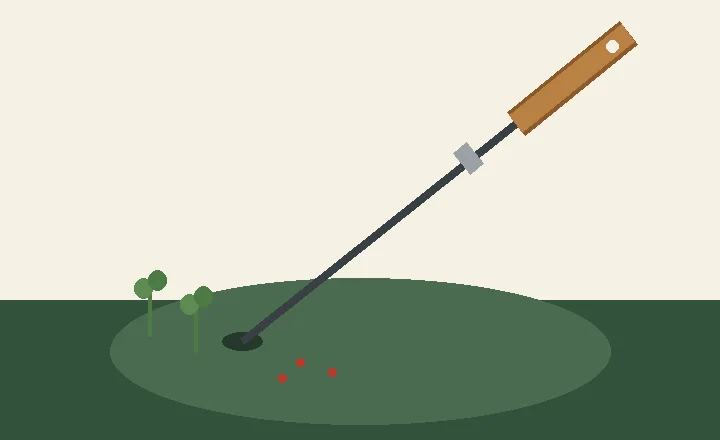
What a dibber is for
A dibber is a pointed tool for pressing holes into prepared soil. Unlike a trowel, it does not lift or carry soil; it displaces it, so the hole is clean, the seed sits at a consistent depth and the surrounding bed is left undisturbed. That makes it the right tool for sowing single seeds such as tomatoes, courgettes, sweet corn and climbing beans, for setting out transplants, for planting bulbs, and for marking a straight line before you sow a row.
It is not a digging tool. Do not use it to break ground, lift crops or pry stones, and be careful in stony soil where a thin shaft can snap if you force it.
Choose the right dibber
Simple pointed sticks, in wood or steel, are the basic form. A dibber with a depth ring or collar limits how far the point travels, which is what makes the depth repeatable from hole to hole. A bulb or shaped handle gives a firmer grip and a place to hang the tool in storage.
Match the point to the job. A slim point enters seed trays, modules and firm beds with less disturbance and suits small seeds. A thicker, longer dibber opens a hole wide enough for a transplant root ball or a bulb. Steel points hold their shape in firm or slightly stony ground; wooden dibbers are light and inexpensive but the point wears down and blunts over time.
Set the depth ring to match the current crop's sowing requirements. A ring set too deep can bury small seeds too deeply, and a bent ring can give the wrong depth, so check it before you start.
Make consistent holes
Try pressing the dibber straight down with a short, even stroke. Avoid twisting or rocking it, which can widen the hole or disturb the sides depending on soil conditions. Keeping a similar wrist motion and angle may help, but check actual hole depth as you work, whether or not you use a ring.
Follow the seed packet's instructions for the depth a particular crop wants. As a general working rule, most seeds are sown at roughly two to three times their own diameter, but crop-specific instructions take priority. Set the depth ring to the required depth and check the holes as you work. For a row, mark the line first with a stick or the edge of the dibber, then work along it at the spacing the crop needs.
Place the seed in the hole, cover it according to the crop's sowing instructions, then gently firm the covering soil and water according to the crop and conditions. In dry weather, water the bed before sowing or water the sown spot after covering, so the seed has moisture to germinate.
Sow seeds and set out transplants
Seeds: Make one hole at the crop's required depth, place one seed in it, cover according to the sowing instructions, gently firm the covering soil and water according to the crop and conditions. Transplants: Use the dibber to mark the required depth, but a root ball often needs a wider hole; open it with a hand trowel if needed. Follow crop-specific planting-depth guidance; where it calls for the same depth as in the pot, keep that level and firm the soil around the roots. Bulbs: Point the base down and set the bulb at the depth the variety calls for, commonly a couple of times the bulb's height, then cover and firm.
The dibber keeps depth even, but spacing is still on you. Measure or mark the interval the crop needs and keep to it, because a consistent depth does not fix a crowded row.
Dibber or trowel?
Use each for what it does well. The dibber is faster for sowing, disturbs less soil and holds depth; the trowel opens wider holes, lifts and moves soil, and handles root balls and stony ground. A common pairing is to dibber the sowing and use the trowel for transplanting and any hole too wide for the point.
Clean and maintain the dibber
Remove soil before it hardens and dry the tool before storage. Check the depth ring is straight, and retire a wooden dibber once the point has worn down to a stub.
Clean the tool between different jobs and disinfect it when moving from diseased material to healthy plants, as with any hand tool. Store it dry, ideally hung from its hole, and do not use it as a lever or to pry stones.