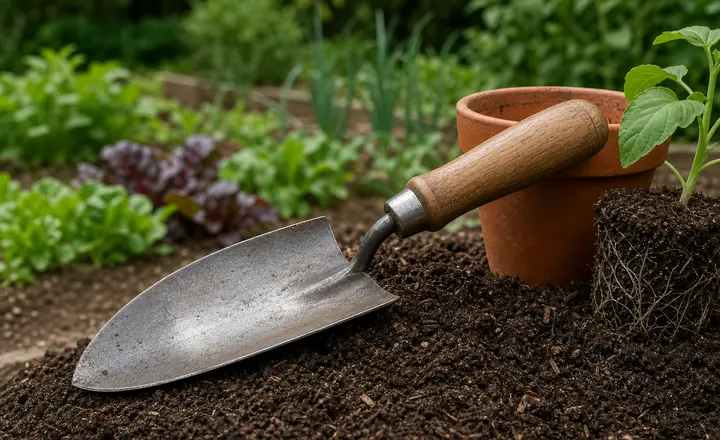
Match the blade to the ground
Choose a trowel blade for the task Task Blade shape Limitation Moving compost and potting mix Broad and dished (scoop-shaped) Not for prying large stones or cutting thick woody roots Planting in confined spaces between established plants Narrower; also enters dense or stony soil with less resistance Not for prying large stones or cutting thick woody roots Trowels marked with depth measurements can help place bulbs or transplants, but the scale is useful only when the blade is inserted vertically and the markings remain visible.
Look for a blade and tang made as one strong piece or joined without a weak, narrow transition. The neck is often where inexpensive trowels bend when used as levers. No hand trowel should be used to pry large stones or cut thick woody roots.
Choose a grip for control
Hold the trowel with the gloves you normally wear. The grip should fill the hand without forcing the wrist sideways, and there should be no sharp seam or ridge under pressure. Bright handles are easier to find in beds, while a hanging hole makes dry storage straightforward.
Weight should feel balanced near the hand. Very heavy blades may seem strong but become tiring during repeated potting. Gardeners with limited hand strength may prefer a larger, shaped grip, though the best form depends on the individual.
Use short movements close to the work
For transplanting: 1. Open a hole wide enough to accept the root ball without folding roots upward. 2. Support the plant by its leaves or root ball rather than crushing the stem. 3. Settle the plant at the appropriate depth for the crop. 4. Firm the surrounding soil gently. 5. Water according to the crop and conditions rather than automatically flooding every hole.
Keep the wrist neutral, avoiding bending it sideways, and use your forearm for short digging strokes. In resistant ground, loosen a wider area first instead of twisting the trowel. Use a scoop or dedicated container for potting mix if repeated contact with the bag would contaminate clean potting mix.
Clean between different jobs
Routine cleaning checklist: 1. Remove soil before it hardens and clean off plant residue, using a method appropriate for the blade and handle materials. 2. Rinse or wipe away any cleaning product residue as directed. 3. Dry the blade. 4. Check the tang and handle regularly; stop using the trowel if the blade is loose or the grip is split.
When moving from diseased material to healthy plants, disinfect the cleaned tool using a method appropriate for the blade and handle materials. Rinse or wipe away any product residue as directed, then dry the blade. If an edge is rolled, smooth it with a file only if the blade is designed to take an edge.