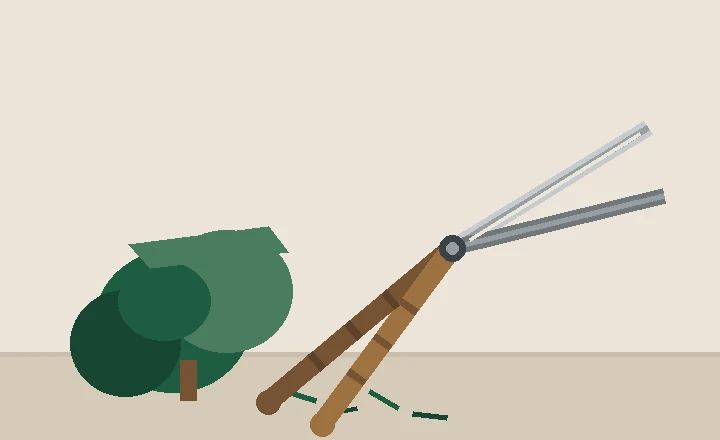
Know when shears are the right tool
Garden shears suit dense, soft growth on hedges, shrubs and topiary. The RHS recommends hand shears for small hedges and soft growth; powered trimmers make larger hedges easier to tackle. For individual woody stems, choose secateurs for smaller stems, or loppers for thicker stems within the tool's stated capacity. Both allow selective pruning of large-leaved evergreen hedges without cutting across the leaves.
Use garden shears to trim soft growth; use pruning tools for woody stems, deadwood and structural pruning. A cut deeper inside a shrub does not automatically require a saw: choose according to stem thickness, access and the tool's stated capacity. For branches beyond the capacity of suitable secateurs or loppers, use a pruning saw rather than forcing a bladed pruning tool through the branch.
Choose scissor-action hedge shears
The Burgon & Ball guide distinguishes scissor-action hedge shears, with two sharpened blades moving against each other, from bypass and anvil pruning tools. Scissor-action shears trim soft growth. Bypass secateurs and loppers suit individual living stems; anvil tools suit deadwood but can crush soft growth. These pruning-tool distinctions do not make hedge shears suitable for deadwood or branches.
Compound action uses additional levers to increase cutting force; it does not establish how much growth the shears remove per stroke. Choose a pair you can handle comfortably, and confirm that the blades close properly through the handles' normal range of movement.
Match the blade shape to the hedge
Long shear blades trim an area of soft growth rather than picking out individual stems. Check blade length and edge design alongside handle comfort and alignment. The Burgon & Ball cutting-tools guide describes wavy edges that help catch growth when trimming higher hedges.
Try the shears before you buy. Open the handles fully and check the span is comfortable with gloves on, and that the pivot is firm with no sideways play. Look for a secure bolt, undamaged grips and blades that pass closely without colliding.
Trim in the right order
Walk the hedge before you start. In the UK it is an offence under the Wildlife and Countryside Act 1981 to damage or destroy the nest of any wild bird while it is in use or being built, so the RHS advises checking for active nests and delaying trimming until the young have fledged. Then cut the sides before the top: start at the bottom and work upwards, keeping the blades parallel to the side of the hedge, and use a string line or straight edge as a guide.
For formal hedges, keep light reaching the base: the RHS allows vertical sides below about 1 m, and recommends tapering taller hedges or optionally chamfering their upper sides at 45 degrees. For a straight top, set the string about 1 cm below the intended height. The advice to retain about 1 cm of new growth relates to maintaining an undulating or shaped top, measured from previous cuts. The RHS trimming guide describes trimming as light pruning, generally of growth under a year old. Its companion pruning guide gives established formal hedges one to three trims annually depending on species; informal hedges usually need one, timed to protect flowering where desired. Follow species-specific advice rather than a universal calendar. Trim lightly initially: most conifers cannot regrow from old wood, but yew is an exception. Rake clippings off the finished surface so light reaches the cut stems, and use a garden rake to tidy the ground beneath.
Maintain the blades and pivot
Wipe sap and moisture from the blades after use and dry them to limit corrosion. Clean the blades and, when disease is a concern, disinfect them between affected and healthy plants with a product and contact time suitable for pruning tools. Check the alignment: the shear blades should pass each other closely without binding or colliding, and the bolt should stay secure without being over-tightened, which binds the action.
Follow the manufacturer's instructions for sharpening your specific shears; these take precedence over general advice. Use an oilstone or fine file only if recommended for that blade profile, preserving the specified bevel and removing as little metal as necessary to restore a clean cutting edge. Wavy or other shaped edges may require a different method or professional servicing. Lubricate the pivot lightly in line with the manufacturer's guidance. A cracked bolt, bent blade or loose joint is a reason to stop using the shears until they are properly repaired or replaced.
Sources and review basis
- How to trim a hedge — Royal Horticultural Society
- Pruning hedges — Royal Horticultural Society
- Anvil, bypass or scissor? A guide to loppers and shears — Burgon & Ball
Tool-choice, hedge shape, cutting order, nesting-season and trimming-frequency guidance follows the RHS, while cutting-action distinctions and wavy-edge behaviour follow the Burgon & Ball cutting-tools guide. Blade care is general guidance, subject to the model-specific instructions described above. Local regulations take precedence over the general nesting-season note.